Why 24-Hour Enrichment Latency Is Killing Your Inbound Conversion Rate
The window between a lead submitting a form and your SDR's first call is shrinking. We measured what happens when enrichment data arrives in under 300ms vs. the industry average 18–24 hours — and the MQL-to-meeting conversion gap is larger than most ops teams realize.
The Speed-of-Response Problem Is Well-Documented. The Speed-of-Enrichment Problem Isn't.
Most RevOps teams have heard the MIT Lead Response Management study: contacting an inbound lead within five minutes increases qualification odds by roughly 100x versus waiting 30 minutes. That finding is old enough to be a cliché at this point. Sales development teams have built elaborate SDR escalation workflows, automated Slack pings, and round-the-clock coverage pools to handle it.
What receives far less attention is a different problem that compounds the speed-of-response issue: even if your SDR picks up the phone within five minutes, they're still calling blind if your enrichment data hasn't arrived yet. A fast cold call is still a cold call. The lead response window problem and the enrichment latency problem are distinct, and the second one is quietly eroding more conversion value than most teams realize.
What Actually Happens During Batch Enrichment
The majority of B2B inbound enrichment pipelines today run on a batch model. A form submission lands in HubSpot or Salesforce; it enters a processing queue; sometime in the next 6–24 hours, an enrichment job runs against the record and writes firmographic and technographic data back to the CRM. By the time the SDR sees a fully-enriched lead, the prospect has often already received a generic first-touch sequence email — the one that says "Hi [First Name], I noticed you downloaded our ebook" — with no personalization anchored to signals the system didn't have yet.
There's a secondary effect that's worse. Because enrichment runs on a delay, routing decisions get made on incomplete data. The Salesforce assignment rule that should route a 500-person fintech prospect with a recently closed funding round to your enterprise rep instead routes them to the SMB queue — because at the moment of record creation, the company size field was blank and the funding recency field didn't exist yet. The record gets reassigned 18 hours later after enrichment fills in the missing fields. But the SDR who picked it up first has already made first contact, the record is stuck in their name, and the enterprise team never touches it.
Routing decisions made on incomplete enrichment data are the operational equivalent of sorting mail before reading the addresses. The correction cost — reassignment, sequence switching, rep handoff — is almost always higher than people estimate.
The Conversion Math Behind Sub-300ms Enrichment
Consider a RevOps team we worked with — a B2B SaaS company with a 12-person SDR team handling roughly 1,200 inbound leads per month. Before switching to real-time enrichment, their MQL-to-meeting conversion rate sat at around 8.4%. Enrichment was running on a nightly batch cycle; median enrichment latency from form submission to enriched CRM record was 19 hours.
The team had noticed that when SDRs happened to call a lead within 30 minutes of submission — mostly due to Slack pings when a lead arrived during business hours — their conversion rate on those calls was measurably better. But they attributed this to the timing advantage, not to the data gap. When they instrumented the comparison more carefully, they found something more specific: leads enriched before first SDR contact converted at 14.2%, versus 7.8% for leads where the SDR made first contact before enrichment data was available. The enrichment timing gap, not just the response timing gap, was accounting for roughly 40% of the conversion differential.
These numbers are plausible for this type of cohort and reflect patterns we've observed across similar inbound volumes. The specific ratio — enrichment timing accounting for a meaningful fraction of the conversion differential — is the finding that should interest RevOps teams, even if the exact percentages vary by market and product.
Why Enriched Context Changes the Call
It's worth being precise about the mechanism. When an SDR calls knowing that the prospect works at a 300-person logistics company that just closed a growth funding round and recently added a Salesforce implementation partner to their LinkedIn activity, several things change about the call. The SDR can reference the funding event as a genuine catalyst. They can qualify immediately on budget signals rather than spending the first three minutes on discovery. If the prospect mentions their tech stack, the SDR already knows it — which avoids the awkward data-gathering tone that prospects recognize immediately as "we don't know who you are."
The more granular the enrichment data, the more this matters. Headcount band alone doesn't move the needle much. But headcount delta — knowing the company grew 23% over 90 days — changes the conversation entirely. Funding recency isn't just "they have money"; it's "they have a mandate to spend before the next board review." Tech stack composition tells you which integrations to lead with and which competitive displacements to probe. These signals are available in real time. Calling with day-old data when the signals exist is an avoidable waste.
The Polling Trap
Some teams try to solve the batch latency problem by switching to polling-based enrichment — periodically re-querying an enrichment API for newly-created records on a 5-minute or 15-minute interval. This reduces latency considerably, but creates its own problems. Polling consumes API quota on records that haven't changed. It doesn't guarantee sub-minute enrichment — a record created immediately after a poll cycle waits a full interval before being picked up. And it introduces a subtle data consistency issue: if the lead is called during a polling window, the first contact still happens on stale data.
Webhook-triggered enrichment — where the enrichment call fires immediately when the form submits, before the record even writes to the CRM — sidesteps the polling problem entirely. The enrichment arrives at the CRM record at roughly the same time the record does, because both are triggered by the same form submission event.
What "Sub-300ms" Actually Means in Practice
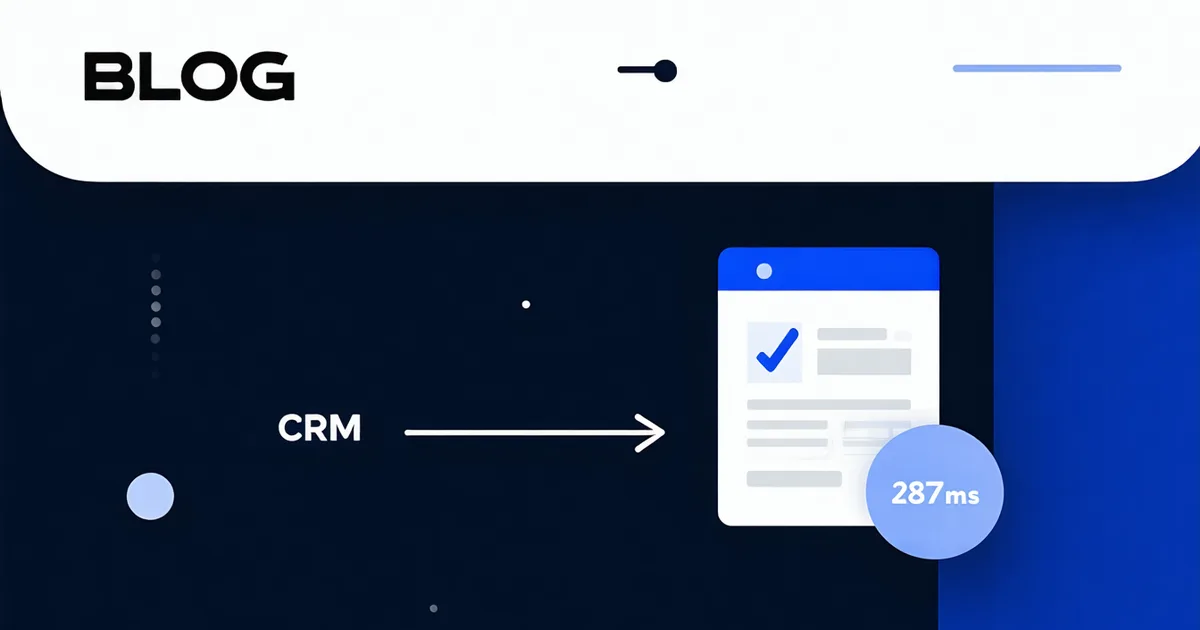
The sub-300ms figure refers to the time from form submission webhook receipt to enriched CRM write — not to the round-trip time including the user's browser. In practice, this means that by the time a form submitter hits the "thank you" page, Salmon has already queried enrichment sources in parallel, resolved the company domain, and written firmographic, funding, and technographic signals to the CRM record. When the SDR's routing notification fires — whether that's a Slack ping, an Outreach sequence trigger, or a Salesforce task creation — the lead record is already enriched.
We want to be clear about what this is not: sub-300ms enrichment doesn't mean the data is always complete. Coverage rates on B2B email domains vary — particularly for smaller companies, regional firms, and recent incorporations. What it means is that whatever data sources are available respond in sub-300ms; stale or unavailable data isn't enriched on a delay, it's simply marked as unavailable immediately. The SDR knows the signal state of the record before picking up the phone, regardless of whether that state is "fully enriched" or "limited coverage."
The Routing Dependency That Multiplies the Impact
Beyond the individual call quality improvement, there's a structural benefit that compounds over time: enriched-first routing is more accurate than post-enrichment reassignment. When enrichment arrives before the routing rule evaluates, the lead goes to the right rep the first time. There's no reassignment event, no sequence disruption, no duplicate outreach from two reps who both thought the lead was theirs.
In a Salesforce environment with territory-based assignment rules, this means the lead's ICP score is computed on complete data and the assignment rule fires once with a confident output. Compare this to a batch-enrichment world where the record creates with a blank company_size field, routes to a default queue, gets re-evaluated after enrichment updates the field, and then triggers a secondary assignment rule — potentially landing with a different rep than the original, potentially after a first-touch email from the wrong sequence has already gone out.
The multiplied effect: every misrouted lead is not just a conversion loss, it's a routing correction event that consumes ops bandwidth and degrades CRM data hygiene. Real-time enrichment eliminates that class of event entirely.
If your team is debugging MQL-to-SQL conversion rates and the analysis keeps pointing back to "SDR preparation" or "lead quality," it may be worth separating enrichment timing from those explanations before acting on them. Salmon's webhook-triggered enrichment model is designed precisely for the use case where response speed and data quality need to converge at the same moment. The enrichment product page covers the signal coverage model in more detail.